
sweet news, for once
|
|||
|
Tuesday, Oct 27 · Five good things · Three minutes
|
|||
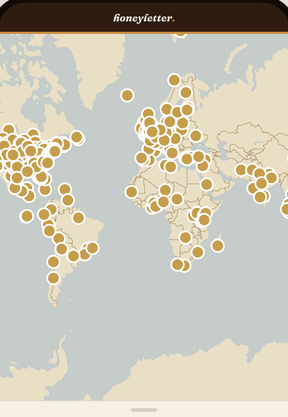 TODAY IN THE APP Every story is real. Pinned on a map, right where it happened. 862 and counting.   |
|||
| |||
|
MEDICINE • ScienceDaily Health
A liquid painted on a tooth stops cavities. No drilling.No drill. No needle. Just a few seconds and a tiny sponge.
A liquid painted onto a tooth in seconds can stop a cavity from getting worse, according to a Phase III clinical trial published in JAMA Pediatrics. The treatment, silver diamine fluoride, arrested decay in more than half of affected baby teeth when applied every six months. Researchers led by the University of Michigan enrolled 830 children younger than 6, recruited through dental clinics and Head Start programs in Michigan, New York, and Iowa. A dentist uses a small sponge tipped applicator to paint the liquid directly onto the decay. No drilling. No injections. The silver fights bacteria while fluoride strengthens the tooth. There is one catch. The treated spot permanently turns dark, which is noticeable on front teeth and entirely cosmetic. Tooth decay affects more than 40% of American children, and untreated cavities send thousands to emergency rooms every year. "This is a very effective and safe treatment, even in children as young as 1," said lead investigator Margherita Fontana. Read the full story → | |||
| |||
|
KINDNESS • Sunny Skyz
Fishermen spotted a kangaroo swimming two miles out and saved himTwo miles out, something was swimming. The skipper was right.
A crew of fishermen on Boston Bay near Port Lincoln, South Australia, spotted a male kangaroo swimming roughly two miles from shore and pulled him aboard their boat. Skipper Ryan Smith saw him first. "He's like, 'I reckon there's a roo in the water.' And we're like, 'Yeah, sure. All right, Ryan, sure,'" said Jake Murray, a farmer and diver on the crew. They doubled back, and it was a roo in the water. The men lowered the boat's sea door to the waterline and lifted the exhausted animal in. Murray held him steady, keeping the powerful legs under control. "Honestly, I was just kind of cradling him there for a while, and it was almost like he was having a little nap," Murray told ABC News Australia. The water was unusually calm that day, which may be the only reason anyone saw him. Back on the beach, the kangaroo sat for a while, then hopped away. Read the full story → | |||
| |||
|
KINDNESS • Upworthy
Deputies traded emergencies for nail polish and pumpkin muffinsThe uniforms usually mean bad news. Not this morning.
Deputies from the Kosciusko County Sheriff's Office spent a recent morning at Grace Village Retirement Community in Winona Lake, Indiana, not responding to an emergency, but painting residents' nails over coffee. Activities director Llesenia Simpson had reached out in September to arrange the visit for the October calendar. A Warsaw Starbucks donated pumpkin muffins. Several residents had already asked to have their nails done, and staff were working through the list when the officers walked in, in uniform and smiling. Sheriff Jim Smith was the first to pull on gloves and ask a resident if he could polish her nails. "Well, you sure can!" she told him. The nail care spread across the room from there. Told he was a natural, Smith had an explanation. "I have girls and grandbabies at home, so I've gotten pretty good at painting nails."
| |||
| |||
|
SCIENCE • Upworthy
He stacked 100 pyramids. Thirty fish species moved in.Someone sank blocks into empty water. The fish disagreed with empty.
A barren patch of the Caribbean Sea off the coast of Grenada now holds about 100 concrete pyramids, each built from 30 cinder blocks, and the fish have moved in. The effort began in 2013, when Phil Saye, owner of the Dive Grenada dive shop, started lowering stacked blocks into water where sea life had nowhere to hide or feed. Within three months, algae and sponge took hold, followed by feather duster worms and lobster. At around 18 months, stony and brain corals began growing on the blocks. The site, known as the Grenada Artificial Reef Project, is now home to over 30 species of fish and 14 kinds of coral. A peer-reviewed 2024 study found the pyramids resemble natural reefs in many respects. Not every version works. A 1970s Florida plan sank up to two million old tires, which storms later scattered across healthy reefs. The concrete, at least, stays put. Read the full story → | |||
| |||
|
NATURE • ScienceDaily Plants & Animals
Scientists found a two-pound fungus they nicknamed D-rexSomething survived the asteroid. It took its time.
Scientists surveying forests in Yunnan, China, have identified a fungus large enough to earn a dinosaur nickname. Dianjunus rex, known as 'D-rex', produces upright reproductive structures that reach 50 cm tall and weigh up to 2.2 kg, the biggest known among the phylum Ascomycota. The team from the Kunming Institute of Botany found the whitish growths sprouting from the woody roots of Chinese cork oaks. Genetic work revealed the fungus was different enough to need a whole new family, Dianjunaceae. A molecular clock analysis traced the lineage to roughly 65 million years ago, about a million years after the extinction that wiped out the non-avian dinosaurs. "After the mass extinction, forests experienced dramatic changes, including the sudden availability of large amounts of dead plant material," said Indunil C Senanayake, the study's corresponding author. As for why it grows so tall, researchers suspect height helps it fling spores further on the wind. It just needed the room. Read the full story → | |||
|
|
|||
|
honeyletter is on iPhone and Android
|
|||
|
honeyletter
|